

UTI Antibiotics: Why a Doctor's Prescription Matters
The Problem
That burning feeling when you urinate. The constant urge to go, even right after you've already been. It's one of the most common reasons women search for UTI antibiotics online rather than book a doctor's appointment.
It's uncomfortable. It can feel awkward to talk about, even with a doctor. And a friend's leftover antibiotic strip, or whatever a pharmacist hands over without asking many questions, feels like the fastest way to make it stop.
It's an understandable instinct. Most women have had a UTI before, or know someone who has, and the pattern feels familiar enough to self-diagnose from the first twinge. Search “UTI antibiotics” or “which antibiotic for UTI” and you'll find no shortage of names, dosages, and confident-sounding advice. Some of it is even accurate, in the right circumstances.
But a urinary tract infection, or UTI, is a bacterial infection. Treating it correctly depends on more than “it feels like last time.” It depends on knowing which bacteria is actually there. It also depends on whether the drug you're reaching for is the one that will clear it.
Why It Happens, and Why a Prescription Matters
A UTI happens when bacteria enter the urinary tract and multiply, most often E. coli from the digestive tract, which is the most common organism behind uncomplicated UTIs. Because the urethra is short in women, bacteria have a shorter distance to travel to reach the bladder. That's a large part of why UTIs are so much more common in women than in men, and why so many women experience more than one over their lifetime.
Since a UTI is a bacterial infection, it usually needs an antibiotic to clear fully. But “an antibiotic” isn't one single answer. Different antibiotics target different bacteria, and no single drug works equally well against all of them.
Bacteria also vary in how resistant they've become to commonly used drugs. Using antibiotics without a confirmed diagnosis is one of the things that can contribute to that resistance over time. An antibiotic that worked for your friend, or for you the last time, may simply not be a match for the bacteria causing this infection.
This is the real reason a prescription matters more than convenience. It isn't about making a simple problem complicated for its own sake. It's about choosing treatment based on your symptoms and medical history, and, when needed, urine testing or a culture, rather than selecting an antibiotic yourself.
A guess might work. It might not. Either way, it can leave the infection incompletely treated, which may mean symptoms persist, the infection comes back, or the bacteria becomes more resistant. That's a worse position than the one you started in, not a neutral one.
How UTI Antibiotics Are Prescribed
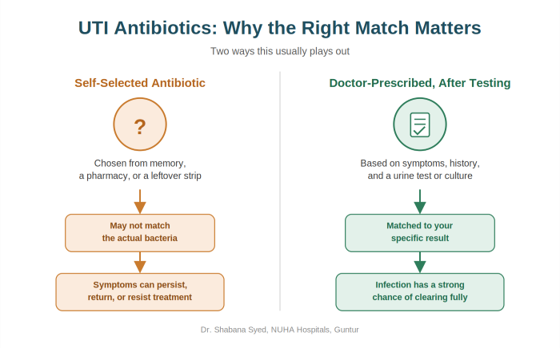
A proper UTI diagnosis starts with a simple urine test, and in some cases a urine culture. The process doesn't require anything invasive: you describe your symptoms, and provide a urine sample.
Depending on your symptoms and clinical picture, your doctor may test before starting treatment, or start treatment and use the test to confirm the diagnosis or guide any changes needed. Turnaround can vary by lab. At NUHA, a preliminary urine result is usually available within about two days, with a full culture and sensitivity report following within about three days where one is needed.
Once the result is back, the doctor chooses an antibiotic based on that result and your medical history. Antibiotic selection also needs to take pregnancy and gestational age into account where relevant.
Commonly prescribed options for uncomplicated lower UTIs include drugs such as nitrofurantoin or fosfomycin, when appropriate for the patient. The specific choice, dose, and length of the course depends on your clinical condition and, where needed, your urine culture and sensitivity result. It isn't something to select for yourself from a pharmacy shelf, or repeat from a previous prescription. Your doctor is matching the drug to your specific clinical picture and lab result, not just to a pattern of symptoms you recognize.
A few things matter once treatment starts.
- Finish the full course your doctor prescribes, even if you start feeling better after a day or two. Taking antibiotics exactly as prescribed, for the full length of the course, gives the treatment the strongest chance of clearing the infection completely.
- Don't reuse a leftover prescription, your own or someone else's, for a new infection. The bacteria causing this UTI may be different from the one you had last time, even when the symptoms feel identical to you.
- Home remedies and hydration can support your recovery, and may help reduce the chance of future infections. They don't replace antibiotics for an active bacterial infection. Some cranberry products have been studied for preventing recurrent UTIs, but the evidence is mixed, with some reviews showing a modest benefit and others showing none. Either way, they shouldn't be used to treat an infection that's already active.
- Not every burning sensation is a UTI. Yeast infections, some sexually transmitted infections, and certain skin irritations can feel very similar in the early stages. A urine test is what actually confirms it, rather than the symptom alone.
When to See a Doctor Promptly
Most UTIs, once correctly diagnosed and treated, clear up within a few days. A few signs mean it's time to see a doctor promptly, rather than wait it out at home.
- Fever, chills, or pain in your back or side can mean the infection has travelled up to your kidneys, which needs prompt attention.
- If you're pregnant, treat any UTI symptoms as something to get checked quickly. Antibiotic selection needs to take your pregnancy and gestational age into account, and untreated infections carry more risk at this stage, for you and for the pregnancy.
- If your symptoms aren't improving after starting treatment, that's worth a follow-up call rather than waiting it out further. Get reassessed sooner, rather than later, if symptoms worsen or you develop fever or flank pain.
- If you're getting frequent or recurrent UTIs, particularly if a culture has confirmed it or you have other risk factors, it's worth having the pattern properly investigated. Treating each episode the same way, and hoping the next one doesn't come, isn't a plan.
- Blood in your urine is always worth getting checked, even if you otherwise feel your usual UTI symptoms and nothing else feels different.
None of these are reasons to panic. They're reasons to get seen, rather than to guess and wait.
Frequently Asked Questions
Can a UTI be cured without antibiotics?
Mild, uncomplicated cases occasionally resolve on their own, but this isn't something to count on or wait for. A UTI is a bacterial infection, and left untreated, it can persist longer than necessary or spread to the kidneys. If you suspect a UTI, the safer path is testing and treatment, not waiting several days to see if it clears by itself while the infection potentially spreads.
What happens if a UTI doesn't respond to antibiotics?
If your symptoms aren't improving after starting treatment, or they get worse, or you develop fever or flank pain, it's worth getting reassessed rather than waiting to see. This can mean the antibiotic doesn't match the bacteria causing the infection. A urine culture is exactly what lets your doctor identify the bacteria directly, and switch to an antibiotic that's actually effective against it, rather than guessing a second time.
Is it safe to use an antibiotic from a pharmacy, or one left over from a previous UTI, without seeing a doctor first?
It isn't recommended. The antibiotic that worked before may not match this particular infection. Using antibiotics without a confirmed diagnosis is also one of the drivers of antibiotic resistance more broadly. That's a problem that makes future infections harder to treat, both for you and for everyone else relying on the same drugs still working.
Does amoxicillin treat a UTI?
Amoxicillin is generally not preferred as a first-line empirical choice in many settings, because antibiotic resistance to it has become common in the bacteria that cause most UTIs. It may still be an appropriate option in specific cases, depending on local resistance patterns and your urine culture and sensitivity result. That's a decision your doctor makes based on test results and current local patterns, not a general assumption either way.
Which antibiotics are commonly used to treat a UTI?
The choice depends on your clinical condition, your medical history, and whether you're pregnant. Commonly used options for uncomplicated lower UTIs include nitrofurantoin and fosfomycin, among others, when appropriate for the patient. Your doctor selects the specific drug, dose, and duration based on your clinical picture and, where needed, your urine culture and sensitivity result, not on what worked once before. That's the whole reason self-selecting a UTI antibiotic isn't advisable, even when a previous course seemed to work.
How many days does UTI antibiotic treatment usually take?
Course length varies by antibiotic and by how straightforward or complicated the infection is. That's another detail your doctor decides, rather than a fixed number that applies to everyone. What matters more than the exact day count is finishing whatever course you're given in full, and getting a follow-up if symptoms are still present once it's done.
Book a Consultation
If you're experiencing UTI symptoms, Dr. Shabana Syed at NUHA Hospitals, Guntur, can arrange the right test, confirm what's actually causing them, and prescribe the UTI antibiotics that are actually appropriate for your infection. That's a more reliable starting point than guessing between a UTI and something that only feels like one. Book a consultation to get an accurate diagnosis and a treatment plan suited to your specific infection.
About Dr. Shabana Syed
Dr. Shabana Syed is a Consultant Gynecologist at NUHA Hospitals, Guntur, holding an M.S. in Obstetrics & Gynaecology and a Diploma in Gynaecological Endoscopy from Germany, along with training from the Kiel School of Gynaecological Endoscopy and Reproductive Medicine. Her training in ultrasonography also supports a more complete diagnostic picture when a patient's symptoms need a closer look beyond a standard urine test.
In Dr. Shabana Syed's own words: “In my practice, I very commonly see patients who come in after self-treating their urinary symptoms, sometimes with antibiotics taken without proper knowledge. In some cases, the symptoms improve temporarily, but the infection may not be completely treated, and incomplete antibiotic use can also contribute to antibiotic resistance.
“During the first consultation, I generally assess the patient's symptoms, duration, severity, associated fever, previous episodes of UTI, relevant medical history, and other risk factors, including pregnancy status where applicable. Depending on the clinical presentation, I may advise urine testing or a urine culture before starting or changing antibiotics. For a straightforward, uncomplicated UTI, I evaluate and treat the patient myself. Patients with recurrent or complicated UTIs, persistent symptoms, suspected upper urinary tract involvement, urinary obstruction, or other concerning features may need further evaluation and referral to a urologist.”
Medically reviewed by Dr. Shabana Syed, M.S. (Obstetrics & Gynaecology), Consultant Gynecologist, NUHA Hospitals, Guntur. Diploma in Gynaecological Endoscopy (Germany), Kiel School of Gynaecological Endoscopy and Reproductive Medicine.

