
ACL Surgery in Guntur: When a Torn ACL Needs Reconstruction, Recovery and Cost
Do you always need surgery for an ACL tear?
No. An ACL tear does not always mean an operation. Some people do well with physiotherapy alone, and others need ACL reconstruction surgery to get a stable knee back. The deciding question is not what the MRI shows but how your knee behaves. At NUHA Hospitals in Guntur, the decision on ACL surgery is made after a careful examination of the knee, with the MRI used to support it.
Articles List
- Normal Delivery vs C-Section: Which Is Better, and Who Decides?
- Meniscus Tear causes, Symptoms and Treatment options
- PCOS vs PCOD Symptoms, Causes and Key Differences
- Lung Cancer Early Symptoms, Diagnosis and Treatment options
- Frozen Shoulder Causes, Stages, Symptoms and Treatment
- Pneumonia Types, Symptoms and Treatment Options
- Migraine
- Pregnancy After 35 Risks, Precautions and Medical Care
- Seizures types, causes and when to seek Emergency Care
- Hip Replacement Cost in Guntur
- Knee Replacement Surgery in Guntur
- UTI Antibiotics: Why a Doctor's Prescription Matters
- Non Surgical Vaginal Rejuvenation or Vaginal tightening
When patients ask Dr. Shaik Nawazish Rabbani, Consultant Orthopaedic Surgeon at NUHA Hospitals, whether they can avoid surgery, his answer is: “Yes, in selected patients. An MRI showing an ACL tear does not automatically mean that surgery is necessary. What matters is whether your knee is stable or not.”
This article explains how an ACL tear is diagnosed and who may manage without an operation. It also covers what ACL surgery in Guntur involves at NUHA, how long recovery takes and what it costs.
What the ACL does and how it tears
The anterior cruciate ligament (ACL) is one of the two ligaments that cross inside the middle of the knee. It stops the shin bone from sliding forward under the thigh bone and keeps the knee steady when you twist or turn [1].
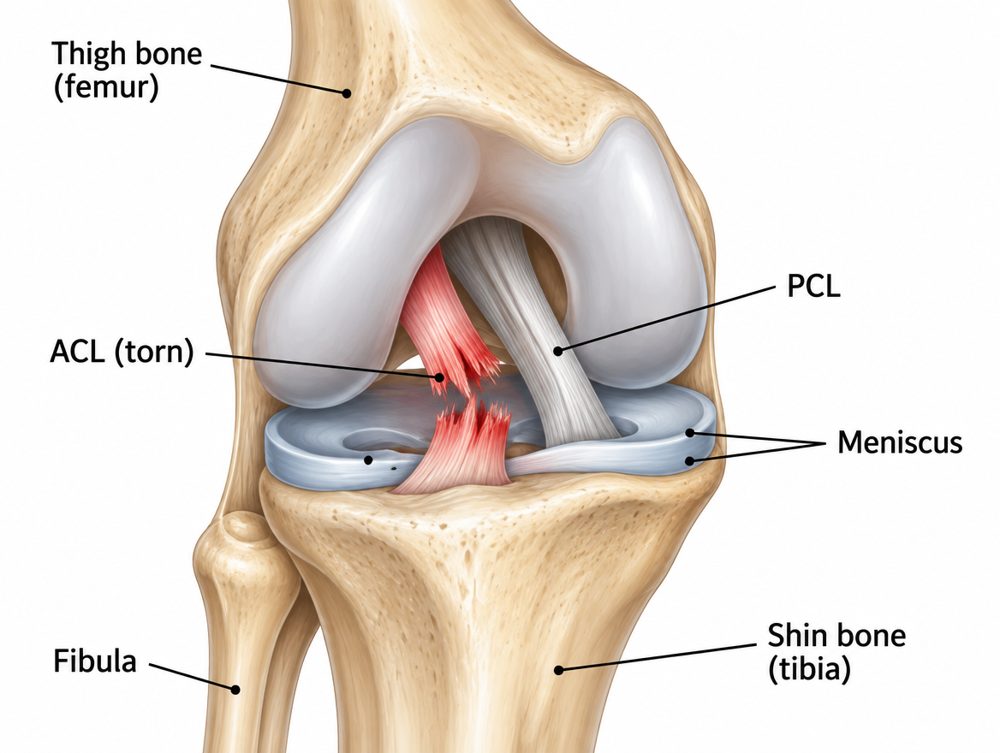
The ACL usually tears without any direct blow. It happens when the foot is planted and the body twists, when you stop suddenly, change direction quickly or land badly from a jump. Cricket, kabaddi and football all involve these movements. A fall from a two-wheeler or a slip on a wet floor can do the same.
About half of ACL injuries happen together with damage to other parts of the knee, such as the meniscus (the cushioning cartilage), the joint cartilage or other ligaments [1]. This is one reason a twisted knee needs a proper examination, not just rest.
Signs of an ACL tear
Common signs after a twisting injury include:
- a “pop” felt or heard at the moment of injury
- swelling of the knee within the first few hours
- pain and difficulty putting weight on the leg at first
- the knee feeling loose, or “giving way” when you turn or climb stairs
- being unable to straighten or bend the knee fully
The pain and swelling often settle in two to three weeks. Many people take that as a sign the knee has healed and go back to their routine. The instability can remain, and each episode of the knee giving way can injure the meniscus or cartilage further.
This is the pattern Dr. Nawazish sees most often in Guntur. Most ACL injuries he treats come from cricket, kabaddi and football, road traffic accidents and everyday twisting injuries. “Many patients initially mistake the tear for a minor sprain and delay specialist consultation for weeks or months, often trying rest, analgesics, massage, or traditional bone-setters first,” he says. “By the time they present at the clinic, repeated episodes of knee instability have frequently resulted in secondary meniscal damage.”
How an ACL tear is diagnosed at NUHA
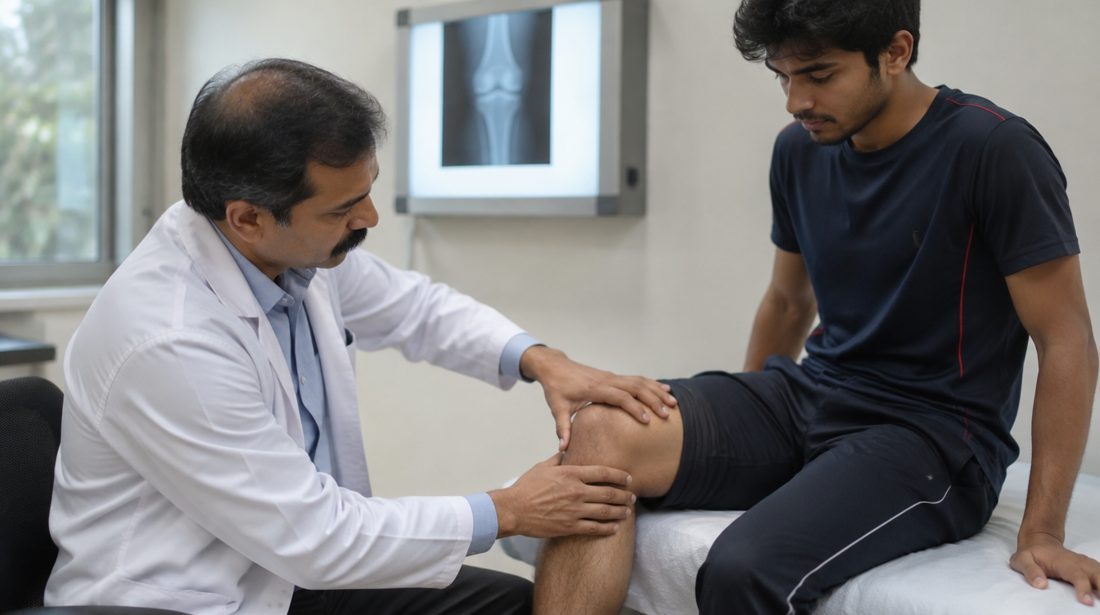
Diagnosis at NUHA starts with the patient, not the scan. In a swollen, twisted knee, Dr. Nawazish says the team first takes a detailed history of how the injury happened. Then comes a clinical examination of the swelling, range of movement, joint tenderness and ligament stability. The stability tests include the Lachman test, the anterior drawer test and the pivot shift test, which show how much the shin bone moves in relation to the thigh bone.
The MRI comes next. It helps identify the ACL tear and any injury to the meniscus, cartilage or bone. In his words, “MRI should complement a good clinical examination.”
This approach is close to his own research. He carried out a study comparing clinical laxity testing of ACL-deficient knees with what was actually found during arthroscopy, the keyhole camera examination of the joint. The hands-on examination tells the surgeon how unstable the knee is, which an MRI picture alone cannot show.
Can an ACL tear be treated without surgery?
Yes, in selected patients. Treatment without surgery means a structured physiotherapy programme. It strengthens the thigh and hip muscles and retrains balance and control, so the muscles take over part of the work of the torn ligament.
Good evidence supports trying this path for some people. A Swedish randomised trial followed 121 young, active adults with a fresh ACL tear [2]. One group had early reconstruction plus rehabilitation. The other had rehabilitation, with the option of surgery later if needed. After five years, knee function, activity and quality of life were similar in both groups, and about half of the rehabilitation group had not needed an operation at all [2]. Those who did have surgery later mostly chose it because the knee kept giving way.
Dr. Nawazish’s own advice has changed over the years. “Earlier in my career, I recommended surgery more readily for young, active patients,” he says. “Today, I take a more individualized approach guided by functional instability, activity demands, associated injuries, and personal goals. While reconstruction remains the preferred option for recurrent instability or pivoting sports, not every ACL tear requires surgical intervention.”
Treatment without surgery may suit people whose knee feels stable in daily activities and who do not play sports with twisting and turning. It also depends on there being no other injury that needs surgery, such as a repairable meniscus tear.
Surgery is more likely to be advised when:
- the knee keeps giving way during normal activities
- you want to return to sports involving pivoting, jumping or quick turns
- there is a meniscus tear that can be repaired
- more than one ligament is injured
A partial ACL tear is often treated with physiotherapy first. Whether it needs surgery depends on how stable the knee is on examination, not on the percentage reported on the MRI.
ACL reconstruction surgery at NUHA Hospitals
A torn ACL does not heal back together on its own in most people, so the operation replaces it rather than stitching it. This is called ACL reconstruction.
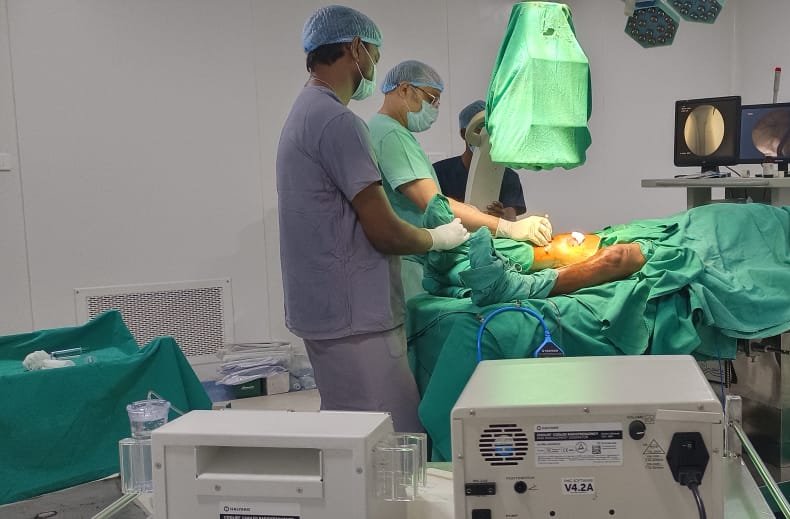
At NUHA, ACL reconstruction is done fully by keyhole (arthroscopic) surgery, through small cuts around the knee. A tendon graft is used to make the new ligament. The graft Dr. Nawazish commonly uses is the hamstring tendon, taken from the back of the thigh of the same leg. Both single-bundle and double-bundle reconstruction are performed.
If the meniscus is also torn, it is repaired in the same operation whenever possible. Repairing the meniscus, rather than removing the torn part, helps protect the knee joint in the long run.
The hospital stay after ACL surgery at NUHA is short, usually one to two days.
Risks of ACL surgery
Like any operation, ACL reconstruction carries some risks. They include:
- infection of the knee wound, usually treated with antibiotics
- a blood clot in the leg (deep vein thrombosis)
- uncommonly, damage to nerves or blood vessels during surgery
- ongoing pain or stiffness, or difficulty moving the knee
- problems where the graft was taken from
- the new graft tearing, which may need further surgery
Most people who have ACL surgery have no complications, and those that occur are usually minor and treatable [3]. Your surgeon will explain the risks that apply to you before the operation, and following the physiotherapy plan lowers the risk of stiffness and re-injury.
Recovery after ACL surgery
Rehabilitation starts before the operation. Dr. Nawazish now places far greater emphasis on prehabilitation, exercises before surgery to settle the swelling and regain movement and muscle strength.
Patients walk with crutches within 24 hours of surgery. They then move on to a knee brace as the knee settles. Physiotherapy begins early and is done in-house at NUHA, so the same team follows the recovery.
A typical timeline at NUHA looks like this:
| Activity | Usual time after surgery |
|---|---|
| Walking with crutches | Within 24 hours |
| Desk work | 1 to 2 weeks |
| Riding a two-wheeler | 6 to 8 weeks |
| Running | 3 to 4 months |
| Sports | 9 to 12 months |
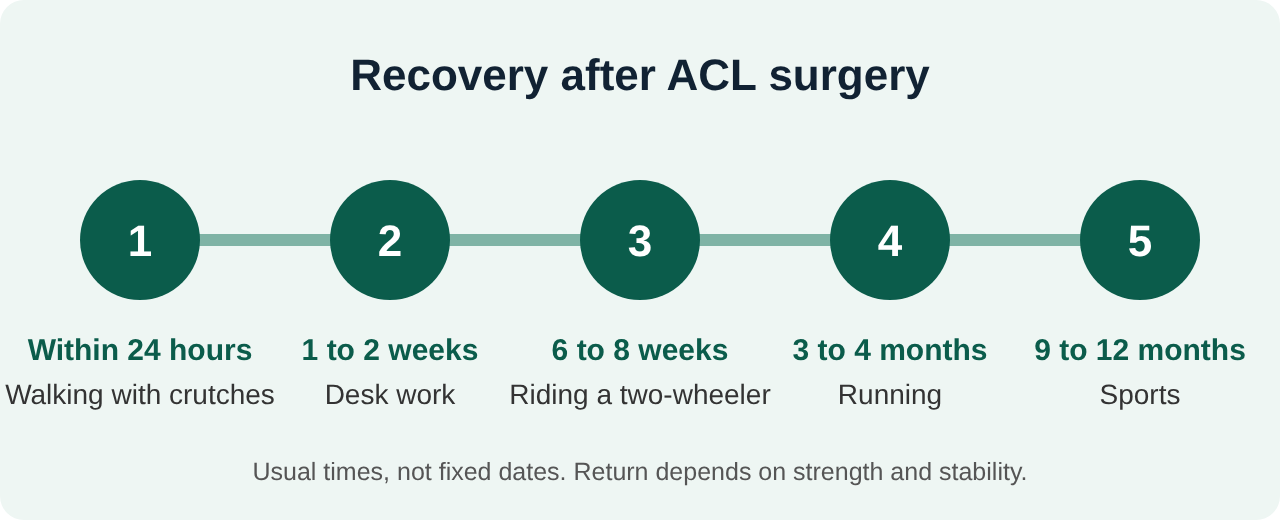
Usual recovery times after ACL reconstruction. Your own timeline depends on strength and stability, not the calendar.
These are usual timeframes, not fixed dates. Recovery depends on the graft, whether the meniscus was repaired, your age and fitness, and how regularly you do the physiotherapy. Dr. Nawazish uses criteria-based recovery milestones, such as strength and stability, rather than relying only on the calendar.
From his practice, what works and what does not is clear. “Initiating early, structured physiotherapy has consistently yielded the strongest outcomes in my practice,” he says. “A disciplined focus on quadriceps strengthening, neuromuscular control, and a phased return to sport works remarkably well. Conversely, delaying rehabilitation or allowing patients to resume sports before regaining adequate strength and stability frequently leads to poor recovery and reinjury.”
Cost of ACL surgery in Guntur
The cost of ACL reconstruction surgery at NUHA Hospitals is around Rs 1.25 lakh. The final amount can vary with the type of reconstruction, whether a meniscus repair is needed and the length of stay.
NUHA Hospitals accepts health insurance and Aarogyasri for ACL surgery. Coverage depends on your policy or scheme, so confirm it with the hospital’s insurance desk before admission. For questions about the cost of ACL surgery, see the contact details at the end of this article.
Do not ignore a swollen knee after a twist
Asked for the one thing everyone should know, Dr. Nawazish says: “Do not ignore a swollen knee after a twisting injury, even if the pain settles.” An ACL or meniscus injury may be serious, and an early diagnosis gives you the widest choice of treatment.
See an orthopaedic doctor promptly (see orthopaedic care at NUHA) if, after a twisting injury:
- the knee swelled up within a few hours
- the knee gives way or feels unstable
- the knee locks or catches and will not straighten
- you cannot put weight on the leg
Questions patients ask
Is ACL surgery a major surgery?
ACL reconstruction is a planned keyhole operation done under anaesthesia, through small cuts. It is not as large as a joint replacement, and at NUHA the hospital stay is usually one to two days. It still needs months of physiotherapy, so plan your recovery time before you decide.
Is ACL surgery very painful?
You do not feel the operation, because of the anaesthesia. Afterwards there is pain and swelling for the first days, which is managed with medicines, ice and elevation. Most people find the pain settles steadily over the first two weeks as physiotherapy starts.
How long does it take to walk after ACL surgery?
At NUHA, patients walk with crutches within 24 hours of surgery, then move on to a knee brace. Most people go back to desk work in one to two weeks and ride a two-wheeler again at six to eight weeks.
Does a 50% ACL tear need surgery?
Not necessarily. A partial tear is often treated with physiotherapy first. The decision depends on whether the knee is stable on examination and during daily activity, not on the percentage written in the MRI report.
Can you recover fully after ACL surgery?
Many people return to their earlier work and sport after ACL reconstruction and rehabilitation. Still, no one can promise a complete return for every patient. Your result depends on any other damage inside the knee, how faithfully you follow physiotherapy and how soon you go back to sport.
Does ACL surgery last a lifetime?
A well-healed ACL graft is meant to be permanent. It can tear again with a new injury, particularly if you return to sport too early. The risk of arthritis in the knee later in life is higher after an ACL injury, whichever treatment you choose [2].
ACL and knee injury care at NUHA Hospitals
NUHA Hospitals has knee arthroscopy, MRI and in-house physiotherapy under one roof, so diagnosis, surgery and rehabilitation are handled by the same team. Treatment is decided after examination, and patients who can be managed without surgery are offered that path first.
NUHA Hospitals is on Old Bank Road, Kothapeta, Guntur. If you have twisted your knee and are unsure whether you need ACL surgery, consult your doctor and bring any X-ray or MRI reports you already have. For knee and sports injury care at NUHA Hospitals, see the contact details. You can also read about knee arthroscopy at NUHA.
Phone: 0863-2255559 or +91 70360 02657
Address: #12-19-61 & 62, Old Bank Road, Kothapeta, Guntur, Andhra Pradesh 522001
Medically reviewed by Dr. Shaik Nawazish Rabbani, M.B.B.S., M.S. (Orthopaedics), Consultant Orthopaedic Surgeon and Director, NUHA Hospitals, Guntur. Registered medical practitioner, Andhra Pradesh Medical Council, Reg. No. 66216.
Last reviewed: 24 November 2026
This article is for general information and does not replace individual medical advice. Whether you need ACL surgery can only be decided after a personal consultation and examination.
How this article was prepared: The medical content in this article is based on Dr. Shaik Nawazish Rabbani’s own clinical experience and the reliable published sources cited below. AI helped draft and organise the text. Every clinical statement was reviewed and approved by Dr. Shaik Nawazish Rabbani before publishing.
References
- American Academy of Orthopaedic Surgeons. Anterior Cruciate Ligament (ACL) Injuries. OrthoInfo. About half of ACL injuries occur with damage to other structures in the knee, such as articular cartilage, meniscus or other ligaments. https://www.orthoinfo.org/diseases--conditions/anterior-cruciate-ligament-acl-injuries
- Frobell RB, Roos HP, Roos EM, Roemer FW, Ranstam J, Lohmander LS. Treatment for acute anterior cruciate ligament tear: five year outcome of randomised trial. BMJ. 2013;346:f232. doi:10.1136/bmj.f232. 121 young active adults; no difference in patient-reported outcomes at five years between rehabilitation plus early reconstruction and rehabilitation with optional later reconstruction. https://www.bmj.com/content/346/bmj.f232
- NHS. Complications of ACL (anterior cruciate ligament) surgery. Blood clots, wound infection, damage to nerves or blood vessels (uncommon), knee problems including pain, stiffness, graft-site problems and graft tear; most people have no complications. https://www.nhs.uk/tests-and-treatments/acl-anterior-cruciate-ligament-surgery/complications/