
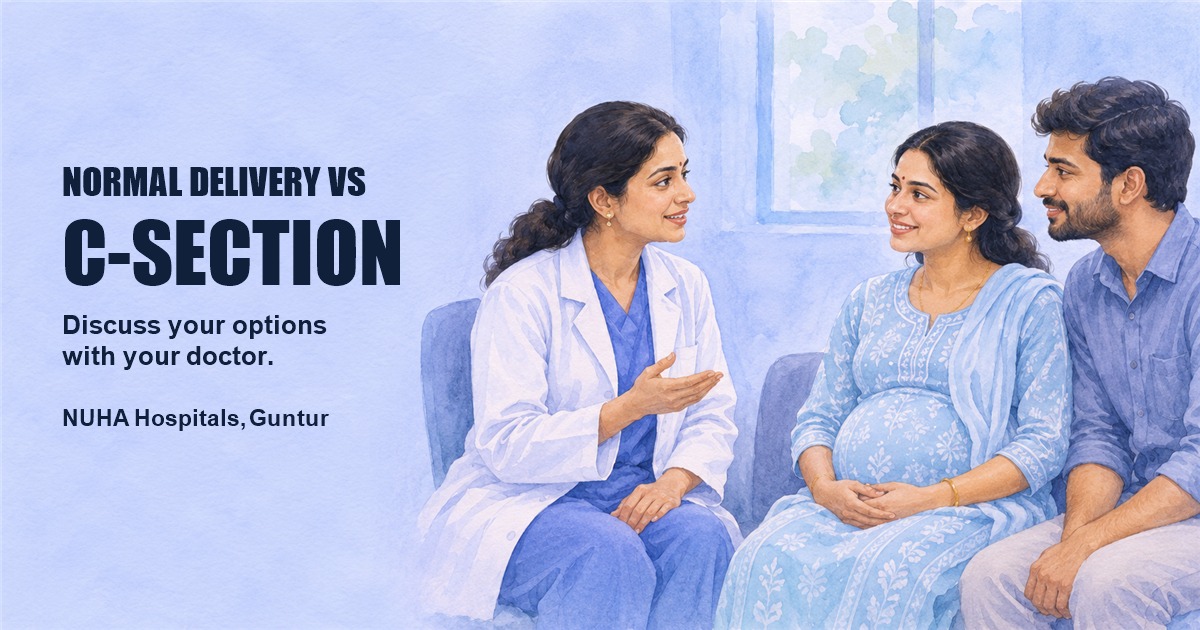
Which is better, normal delivery or C-section?
Neither is better for every mother. A normal (vaginal) delivery and a caesarean section (C-section) are both safe, well-established ways to give birth, and each carries its own benefits and risks. The right route depends on your health, your pregnancy and your baby’s condition. At NUHA Hospitals in Guntur, a C-section is recommended only when there is a medical reason for it.
Dr. Shabana Syed, Consultant Gynaecologist at NUHA Hospitals, puts the most common misunderstanding about normal delivery vs C-section plainly. Many families believe “that C-section is always safer or easier than vaginal delivery, or that vaginal delivery is always preferable.” In her words, “the safest mode of delivery depends on the individual mother, pregnancy and baby.”
Why families struggle with this decision
Many expectant mothers hear strong opinions from relatives and friends. One aunt insists a normal delivery is the only natural way. A friend says a C-section avoids labour pain altogether. Neither view helps much when you are the one deciding.
There is also a real pattern behind the worry. According to India’s National Family Health Survey (NFHS-5), 21.5 percent of births in India are by C-section. The figure is 47.4 percent in private hospitals and 14.3 percent in government hospitals [1]. In Andhra Pradesh, 63 percent of births in private hospitals were by C-section [1].
Numbers like these make families ask whether a C-section is being advised for the right reasons. That is a fair question, and a good obstetrician will welcome it. In Dr. Shabana’s experience, almost every family she sees hopes for a normal delivery.
Articles List
- ACL Surgery in Guntur: When a Torn ACL Needs Reconstruction, Recovery and Cost
- Meniscus Tear causes, Symptoms and Treatment options
- PCOS vs PCOD Symptoms, Causes and Key Differences
- Lung Cancer Early Symptoms, Diagnosis and Treatment options
- Frozen Shoulder Causes, Stages, Symptoms and Treatment
- Pneumonia Types, Symptoms and Treatment Options
- Migraine
- Pregnancy After 35 Risks, Precautions and Medical Care
- Seizures types, causes and when to seek Emergency Care
- Hip Replacement Cost in Guntur
- Knee Replacement Surgery in Guntur
- UTI Antibiotics: Why a Doctor's Prescription Matters
- Non Surgical Vaginal Rejuvenation or Vaginal tightening
What helps a normal delivery
Dr. Shabana advises mothers to stay active during pregnancy: keep walking and carry on with regular household work, rather than spending long hours sitting with the mobile phone, unless your doctor has advised rest.
She also stresses diet. A good diet helps the baby grow healthy. In her experience, a healthy baby can tolerate the stress of labour, which helps towards a successful vaginal delivery. A baby that is not growing well in the womb (fetal growth restriction) is more likely to show fetal distress during labour, which is one of the common reasons for a C-section.
These habits improve the chances; they cannot rule out a C-section. Some C-sections are needed for reasons no mother can control, such as the position of the baby or the placenta.
Normal delivery vs C-section: how they differ
Normal delivery means the baby is born through the birth canal after labour. Labour may start on its own or, in some situations, be started by the doctor.
A C-section is an operation in which the baby is delivered through a cut in the lower abdomen and the uterus. It is usually done under spinal anaesthesia, so the mother is awake but numb from the chest down.
| Normal delivery | C-section | |
|---|---|---|
| How the baby is born | Through the birth canal | Through an incision in the abdomen and uterus |
| Usual hospital stay at NUHA | About 1 to 2 days after an uncomplicated delivery | About 2 to 4 days, depending on recovery |
| Getting back to routine | Gradual, as comfort allows | Longer; activity increases over several weeks, with no heavy lifting until recovered |
| Breastfeeding | Can usually begin soon after birth | Can generally be started early |
Are there risks with a normal delivery too?
Yes. A normal delivery avoids surgery, but it is not free of risk, and it is fair to know both sides.
- Tears and stitches. The skin and muscle between the vagina and the anus can tear during birth, or a small cut (an episiotomy) may be made. These are stitched and usually heal well.
- Assisted delivery. Sometimes forceps or a vacuum cup are needed to help the baby out in the final stage.
- Heavy bleeding after birth. This can happen after any delivery and is treated promptly in hospital.
- Change of plan during labour. A labour that starts normally can still end in an emergency C-section if the mother or baby develops a problem.
This is why the route of delivery should be decided with your obstetrician, and why it helps to deliver where an operation theatre is ready at short notice.
When is a C-section needed?
Some C-sections are planned, and some are decided during labour.
A planned C-section is done when there is a known reason before labour begins. An emergency C-section is done when an unexpected problem develops for the mother or baby during pregnancy or labour.
Dr. Shabana lists the most common reasons she advises a C-section:
- Fetal distress, when monitoring shows the baby is not coping well with labour
- Failure to progress in labour, when labour slows or stops despite good contractions
- Malpresentation such as breech, when the baby is not head-down
- Placenta previa, when the placenta lies over the opening of the womb
- Certain previous uterine surgeries
- Other specific conditions affecting the mother or baby
For emergencies, NUHA has the operation theatre and anaesthesia available 24x7, with a paediatrician available round the clock for the newborn.
What about a C-section on a chosen date or muhurtham?
Some families ask for a C-section on an auspicious date or time, or without a medical reason. Dr. Shabana’s approach is to sit down with the family, listen to their concerns, and explain the benefits and risks of both routes.
A C-section at NUHA is recommended only when it is medically indicated. It is not scheduled only for convenience when that would be medically inappropriate. The reason is simple: a C-section is major surgery, and surgery without a medical need adds risk without adding benefit.
Can you have a normal delivery after a C-section?
Often, yes. This is called VBAC, or vaginal birth after caesarean.
At NUHA, VBAC is considered for carefully selected women after a previous C-section. Dr. Shabana assesses:
- the type of incision on the uterus in the previous operation
- the reason the previous C-section was needed
- how the current pregnancy is progressing
- whether emergency obstetric care is immediately available, which it is at NUHA, with the operation theatre and anaesthesia ready 24x7
International guidance from the American College of Obstetricians and Gynecologists (ACOG) addresses this directly. Most women with one previous C-section through a low transverse (side-to-side) incision can be counselled about trying labour. Studies show a 60 to 80 percent chance of a successful vaginal birth among women who try [2]. The main risk of trying labour after a C-section is uterine rupture, a tear along the old scar. It happens in about 0.5 to 0.9 percent of women with one previous low transverse incision [2]. It is uncommon but serious, and some women who try will still need a C-section, which is why VBAC is planned in a hospital that can operate at short notice.
Labour pain: what relief is available?
Fear of labour pain is one of the main reasons mothers ask about a C-section. At NUHA Hospitals, epidural analgesia is available for labour pain relief, along with other medical and non-medical methods.
An epidural is an injection of pain-relieving medicine into the lower back, through a thin tube, that numbs the lower body during labour while the mother stays awake. Whether it suits you is decided with the doctor and the anaesthetist during labour.
A family member can also stay with the mother in the labour room at NUHA. For many first-time mothers, that support matters as much as any medicine.
Recovery after each type of delivery
After a normal delivery, most mothers go home within about 1 to 2 days if the delivery was uncomplicated. Everyday activities come back gradually, as comfort allows.
After a C-section, mothers are encouraged to get up and walk early, usually within several hours to the first day, depending on the anaesthesia and their condition. Breastfeeding can generally be started early. The hospital stay is commonly around 2 to 4 days.
How the stitches are checked depends on the type of wound closure and the individual mother. Recovery after a C-section usually takes longer. Activity is increased gradually over several weeks, and heavy lifting is avoided until the mother has recovered adequately.
How much does delivery cost at NUHA Hospitals, Guntur?
At NUHA Hospitals, delivery costs between ₹40,000 and ₹75,000. This range covers both normal and caesarean delivery at NUHA.
Aarogyasri is not accepted at NUHA. Health insurance and some government schemes are accepted, so please confirm your policy or scheme with the hospital before admission.
Antenatal care and scans at NUHA
The route of delivery is rarely decided on the day. It follows from months of antenatal care.
Dr. Shabana’s first advice is about timing. Many mothers in Guntur wait until the third month is over before their first visit to a doctor, and she would like that to change. See your doctor as soon as the pregnancy is confirmed.
At the first visit, she checks whether the dates match the gestational age seen on the scan and confirms that the pregnancy is viable. She also tests the haemoglobin (Hb) and thyroid (TSH) levels. In her experience, these early checks help lower the risk of early miscarriage and pregnancy complications, and they help at the time of delivery and towards a healthy child. They cannot prevent every miscarriage, but they allow problems such as anaemia or a thyroid imbalance to be found and treated early.
After that, antenatal visits at NUHA are scheduled according to the stage of the pregnancy and its risk profile. Colour Doppler scans are used when clinically needed, particularly in a high-risk pregnancy, to assess the baby’s growth, how well the placenta is working, and blood flow to the baby.
When to go to hospital straight away
During pregnancy, contact the hospital or come in immediately if you notice:
- bleeding from the vagina
- leaking of fluid, or your waters breaking
- the baby moving less than usual
- severe or constant abdominal pain
- severe headache, blurred vision or swelling of the face and hands
- regular painful contractions before 37 weeks
Questions patients ask
Is a C-section risky?
A C-section is major abdominal surgery, so it carries risks that a normal delivery does not, including infection, heavy bleeding, blood clots and, rarely, injury to nearby organs. It can also affect future pregnancies. When there is a medical reason, these risks are outweighed by the benefit to mother or baby, which is why a C-section is advised only when indicated.
How painful is a C-section?
The operation itself is not felt as pain, because spinal anaesthesia numbs the body from the chest down. Mothers may feel pressure or pulling. After the operation there is soreness around the wound, which is managed with medicines, and early walking is encouraged as part of recovery.
Is a second C-section risky?
A second C-section is common and usually goes well, but each repeat operation can be more complex, because of scar tissue from the first. If you have had one C-section, ask whether a normal delivery (VBAC) is possible next time, as the answer depends on your previous operation and current pregnancy.
What type of delivery is safest after a C-section?
There is no single answer. For selected women with one previous C-section, a planned VBAC in a hospital with round-the-clock operating facilities is a reasonable option. For others, a repeat C-section is the safer route. The decision depends on the previous incision, the reason for the first C-section and the current pregnancy.
How many hours is a C-section?
A C-section at NUHA usually takes about 45 minutes to 1.5 hours from start to finish, depending on the case. The baby is usually delivered within the first 10 to 15 minutes after the first incision, and even faster in an emergency. Most of the time goes into stitching and closing the layers of the uterus and abdomen.
Is there a limit to how many C-sections you can have?
There is no fixed number that applies to every woman. With each repeat C-section, the risks rise, including scar tissue, the placenta growing too deeply into the uterine wall, and heavy bleeding. Many women safely have two or three C-sections. If you are planning more children after a C-section, discuss it early with your obstetrician.
Why is a C-section more expensive than a normal delivery?
A C-section needs an operation theatre, a surgical and anaesthesia team, and usually a longer hospital stay than a normal delivery. These account for most of the difference in cost.
Antenatal care at NUHA Hospitals, Guntur
NUHA Hospitals is on Old Bank Road, Kothapeta, Guntur. Dr. Shabana’s one message for every pregnant woman is simple: a healthy mother means a healthy child. If you are pregnant and weighing normal delivery vs C-section, discuss it with your doctor at your antenatal visit. Bring your previous scan reports and, if you have had a C-section before, the discharge summary from that delivery. For antenatal care at NUHA Hospitals, see the contact details.
Phone: 0863-2255559 or +91 70360 02657
Address: #12-19-61 & 62, Old Bank Road, Kothapeta, Guntur, Andhra Pradesh 522001
Medically reviewed by Dr. Shabana Syed, M.S. (Obstetrics & Gynaecology), Consultant Gynecologist, NUHA Hospitals, Guntur. Diploma in Gynaecological Endoscopy (Germany), Kiel School of Gynaecological Endoscopy and Reproductive Medicine. Registered medical practitioner, Reg. No. 47969.
Last reviewed: 26 September 2026
This article is for general information and does not replace individual medical advice. The right route of delivery for you can only be decided after a personal consultation and examination.
How this article was prepared: The medical content in this article is based on Dr. Shabana Syed’s own clinical experience and the reliable published sources cited below. AI helped draft and organise the text. Every clinical statement was reviewed and approved by Dr. Shabana Syed before publishing.
References
- International Institute for Population Sciences (IIPS) and ICF. National Family Health Survey (NFHS-5), 2019-21: India Fact Sheet and State Fact Sheet, Andhra Pradesh. Mumbai: IIPS; Ministry of Health and Family Welfare, Government of India. Indicators 54 to 56, births in the 5 years before the survey delivered by caesarean section: India 21.5% overall, 47.4% in private and 14.3% in public health facilities; Andhra Pradesh 63.0% in private and 26.6% in public health facilities. India: https://dhsprogram.com/pubs/pdf/OF43/India_National_Fact_Sheet.pdf ; Andhra Pradesh: https://dhsprogram.com/pubs/pdf/OF43/OF43.AP.pdf
- American College of Obstetricians and Gynecologists. ACOG Practice Bulletin No. 205: Vaginal Birth After Cesarean Delivery. Obstet Gynecol. 2019;133(2):e110-e127. doi:10.1097/AOG.0000000000003078. Most published series show a vaginal delivery rate of 60 to 80% among women attempting a trial of labour after caesarean; most women with one previous low-transverse caesarean are candidates for, and should be counselled about, a trial of labour (Level A); risk of uterine rupture with one previous low-transverse incision about 0.5 to 0.9%. https://www.acog.org/clinical/clinical-guidance/practice-bulletin/articles/2019/02/vaginal-birth-after-cesarean-delivery